
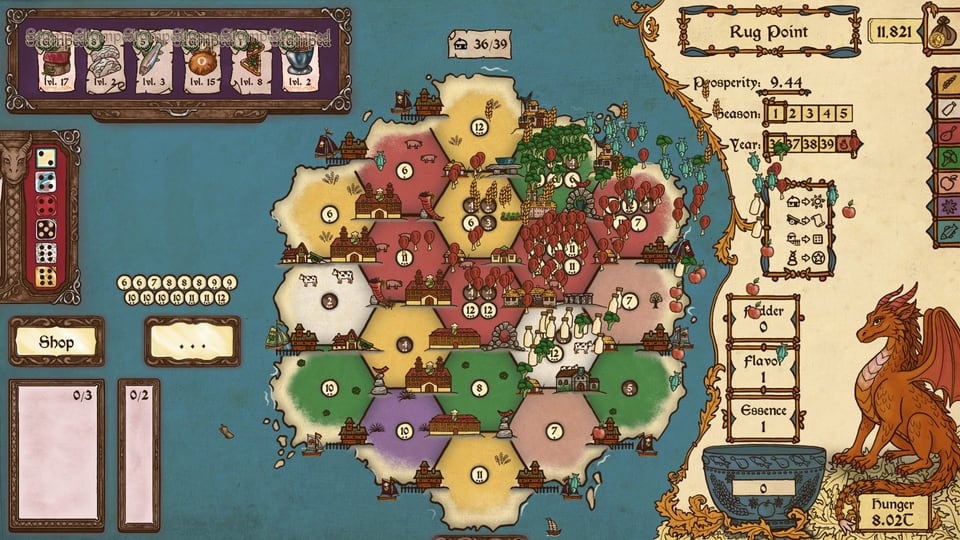
Inspect before you place
One supplied beta run opens the recipe shop before committing Farmstead locations. The principle survives version changes: your first recipe can tell you which ingredient or Mark deserves priority.
Prefer easy shared requirements
A recipe that wants a Mark you already plan to roll is easier to support. A Farmstead location that shares 7, 9, 10 or 11 with another important tile can turn one kept dice set into multiple payouts.
Add a multiplier early
Several supplied videos discover the same lesson: raw Fodder alone falls behind quickly. A Trade Post touching multiple Farmsteads or a reliable Flavor recipe often provides a stronger early jump than one more isolated producer.
Keep money for structural upgrades
Do not arrive at a dice-slot or recipe-slot breakpoint with zero money to use the new capacity. Full-game footage specifically shows the distinction between opening a slot and buying the die that fills it.
Use spare seasons intelligently
If you can finish safely, early completion can build Prosperity. If you cannot, spend the season. A failed year ends the benefit of theoretical future scaling.
A flexible opening sequence
- Check the first recipe options.
- Place Farmsteads around Marks that support those options and share coverage.
- Add one adjacency multiplier/economy piece.
- Buy a recipe you can actually activate.
- Identify the first capacity track your build needs.
- Preserve enough money/tools to use the capacity when it opens.
This is intentionally not a rigid turn-by-turn script: the board and shop are random.
Sources and evidence
- Feed the Scorchpot publisher press kit — current official facts and feature counts.
- Feed the Scorchpot on Steam — current store and release information.
- Our evidence policy and supplied gameplay sources — includes version caveats for demo and beta footage.