
What the release version officially promises
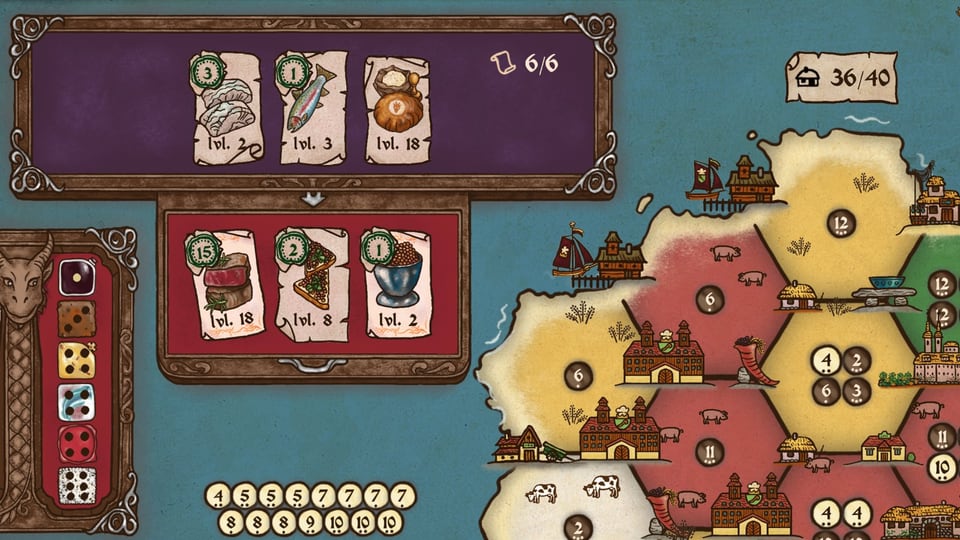
The publisher press kit confirms 80+ recipes. Recipes are not simple collectibles: they are one of the main ways a run converts ingredients into Flavor, Essence, extra Fodder, economy or conditional combo effects.
This site intentionally keeps the launch database on one canonical page until individual recipe names show distinct search demand and enough current-release evidence for a dedicated page.
How recipe activation works
Gameplay footage shows recipes requiring a condition before their effect fires: a certain ingredient amount, an active Mark, a kept die face, a composition restriction, or another board state. A recipe can be powerful on paper and still be dead weight if your board cannot meet its activation condition consistently.
When evaluating a recipe, ask four questions:
| Question | Why it matters |
|---|---|
| Can my board produce the required ingredient? | A multiplier that never activates is worth zero. |
| Does it want a Mark I already target? | Shared Marks reduce reroll pressure. |
| Does it add Fodder, Flavor, Essence or utility? | You need balance across multiplicative layers. |
| Does upgrading increase its activation cost? | More output can reduce reliability. |
Recipe archetypes observed in supplied gameplay
Video-tested, not an exhaustive launch database: names and behaviors below were observed in supplied footage. Exact values must be rechecked in the live Codex before publishing hard numbers.
- Cottage Cheese — tutorial footage uses it to demonstrate a Flavor effect tied to farmsteads.
- Broccoli / Mark recipes — shows the idea of a recipe that wants a specific active Mark.
- Diced Fruit — footage uses it as an Essence-oriented example tied to die values.
- Bacon — a later full-game run describes a pure-meat style effect that rewards keeping the meal focused.
- English Breakfast — footage shows a condition that cares about avoiding spices, useful for understanding composition-restricted builds.
- Ketchup, Pot Luck, Soylent Green, Remarkable Cake — examples of recipes that encourage distinct Mark, ingredient diversity or board-scaling plans.
Best recipe selection rule for beginners
Pick the recipe your board can trigger now, not the recipe with the biggest theoretical ceiling. A reliable Flavor recipe on your existing tiles often contributes more than a spectacular effect demanding an ingredient you barely produce.
Why a second recipe slot matters
Supplied full-game footage repeatedly identifies two simultaneous recipes as a major power spike because effects can multiply or cover different scoring layers in the same cook. That is why unlocking more recipe slots is a progression priority rather than a luxury.
Upgrading recipes safely
Upgrading can increase a recipe’s output, but tutorial footage also warns that a stronger recipe can demand more to activate. Before using an upgrade tool, verify the new requirement will still be reliable. See Recipe Upgrades for the risk checklist.
Database fields to verify from the live Codex
For every launch recipe, the deployment/content agent should capture: name, tier/level, activation cost, ingredient type, Mark or die condition, Fodder contribution, Flavor contribution, Essence contribution, scaling rule, exclusions, and a screenshot/citation. Do not infer missing numbers from old beta videos.
Sources and evidence
- Feed the Scorchpot publisher press kit — current official facts and feature counts.
- Feed the Scorchpot on Steam — current store and release information.
- Our evidence policy and supplied gameplay sources — includes version caveats for demo and beta footage.