
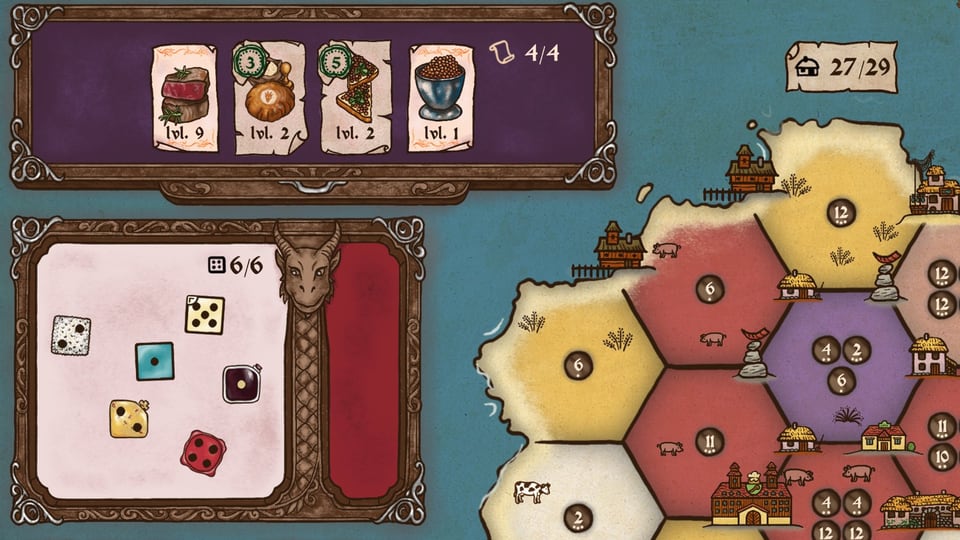
The dice are a build system
The official press kit lists 20+ dice types, including odd, even, colored and highly customized dice. The important point is that a die does more than show one value: every kept die pairs with every other kept die to create Marks.
Three dice versus four dice
Three kept dice create 3 choose 2 = 3 pairwise Marks. Four create 4 choose 2 = 6. That combinatorial jump is why full-game footage treats the fourth die as a major consistency upgrade rather than just “one extra number.”
Example: 6, 5, 4, 1 creates 11, 10, 7, 9, 6, 5.
Try combinations in the Marks Calculator.
High-value and easy-to-hit Marks
A Mark being common does not automatically make it best. Supplied footage repeatedly plans around 10 and 11 when the board rewards them, while other footage notes that 7 is an easy pairwise sum. Your target Marks should come from the board and recipe conditions you actually own.
Colored dice
Gameplay footage shows colored faces interacting with matching tile/resource types. The strategic use is consistency: if your run has already specialized into a resource, a matching colored die can strengthen that plan. Do not buy a color simply because it is offered.
Permanent face editing
Tools seen in supplied footage can adjust die faces for the rest of a run. This is most valuable when you have a clear Mark target. If your engine wants 10 and 11 repeatedly, editing low-value faces toward combinations that produce those sums can reduce dead rolls.
Video-tested: one full-game run specifically notes that a chisel-style edit persists for the run. Recheck exact tool names/effects in the live build before publishing a numerical tool database.
Buying a die versus opening a slot
A new die slot and an actual die are separate decisions in supplied footage. Do not spend all your money unlocking capacity if you cannot afford or find a die to fill it. Conversely, do not buy a specialized die with no slot or no matching board plan.
Sources and evidence
- Feed the Scorchpot publisher press kit — current official facts and feature counts.
- Feed the Scorchpot on Steam — current store and release information.
- Our evidence policy and supplied gameplay sources — includes version caveats for demo and beta footage.