
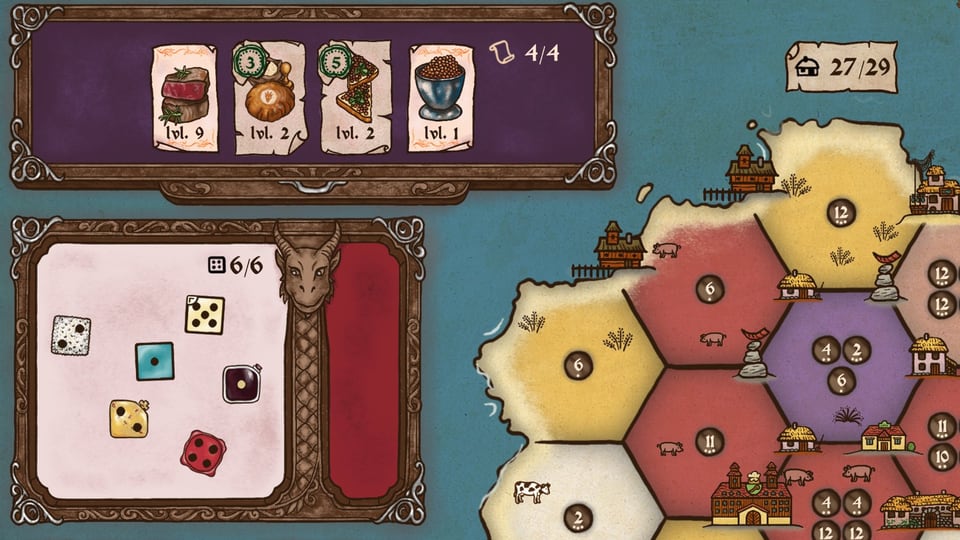
The meal is a multiplication problem
The official press kit says recipes boost Flavor and Essence, multiplying the Fodder score into large totals. Tutorial footage makes the relationship explicit: the bowl combines those layers multiplicatively.
Fodder
Fodder is the raw weight of what you harvested and what some recipes create. More farm production raises the base, but a giant base with weak multipliers can still miss a later hunger target.
Flavor
Flavor is a multiplier commonly supplied by recipes and trade-post-style effects in the tutorial. It is often the easiest place for a beginner to discover why “more ingredients” is not the same as “more score.”
Essence
Essence is another multiplier. Gameplay treats it as harder to acquire early and often ties it to more advanced buildings, recipes, tile interactions or long-term scaling.
Prosperity
Supplied footage shows unused seasons contributing to Prosperity, which in turn strengthens future output and/or economy. Because exact values have changed across footage, this guide treats the direction as reliable but avoids old hard numbers.
A practical balancing rule
When your run is failing, identify the weak layer. If Fodder is tiny, add production or better Mark coverage. If Fodder is healthy but the final meal is weak, add Flavor/Essence. If you are barely surviving every year, improve consistency so you can bank spare seasons rather than chase one enormous theoretical combo.
Why multiplicative balance matters
Improving the smallest multiplier can beat adding more to the already-largest number. That is why a late-game purchase that adds modest Essence may be more valuable than another huge farm when your Fodder is already excessive.
Sources and evidence
- Feed the Scorchpot publisher press kit — current official facts and feature counts.
- Feed the Scorchpot on Steam — current store and release information.
- Our evidence policy and supplied gameplay sources — includes version caveats for demo and beta footage.